Meditative Slow Stitch

The sewing machine has been sitting quiet lately, not because I have run out of ideas, but because the weather has made machine sewing feel like too much. When the room is hot and the air is still, just the thought of wrestling with a quilt under the needle can feel heavy.
So I have moved into a slower rhythm.
Instead of pushing fabric through the machine, I have been sitting with small pieces in my hands, a needle, thread, and a few scraps from recent work. Slow stitching has been just right for these hot days. It asks for very little equipment, very little space, and no hurry at all.

It has also given me a new direction to follow: a series of meditative slow stitch fashion accessories made from fabric scraps and remnants.
The first piece, a fabric brooch, is finished. Now I am working on a fabric pendant. Both pieces use remnants from my recent wave-inspired textile pieces, which are finished but still waiting for binding. Those larger pieces will have their turn when the weather cools down. For now, the small scraps are keeping my hands busy and my mind settled.
Some days are simply not machine-sewing days.
The machine itself is not the problem. I love the speed of it and the way it lets me build a larger piece with energy and movement. But machine sewing asks for a different kind of attention. It needs setup, light, pressing, trimming, and sometimes a bit of wrestling with the fabric.
In hot weather, all of that can feel like too much.
Slow stitching is different. I can sit in a comfortable chair with a small cloth in my lap. I can choose a few threads, thread a needle, and begin. There is no need to stand at the ironing board every few minutes. There is no noise from the machine. There is no pressure to complete a large section before taking a break.
The smaller scale matters too. A brooch or pendant fits in the hand. It can be picked up for ten minutes or worked on for an hour. It does not demand a full studio session.
That is one of the things I love most about slow stitch. It respects the season I am in, both literally and creatively.
When it is too hot to bind quilts, I can still create. When I do not have the energy for a larger construction, I can still make something beautiful. The work changes size, but it does not stop.
Meditative slow stitch
I often describe slow stitching as meditative, but that can mean different things depending on the project.
Sometimes the meditation comes from not knowing what will happen next. That has been true of the intuitive pieces I have been making. With those, I respond to the fabric as I go. One stitch suggests another. A line of thread changes the balance of the piece.
That kind of work can be freeing. It can also be intense, because every step opens up a new decision.
These accessories feel different.
For this series, I know ahead of time what I am making. A brooch. A pendant. Later, perhaps a cuff, a small charm, a stitched patch, or something else meant to be worn. The shape and purpose are clear before I begin.
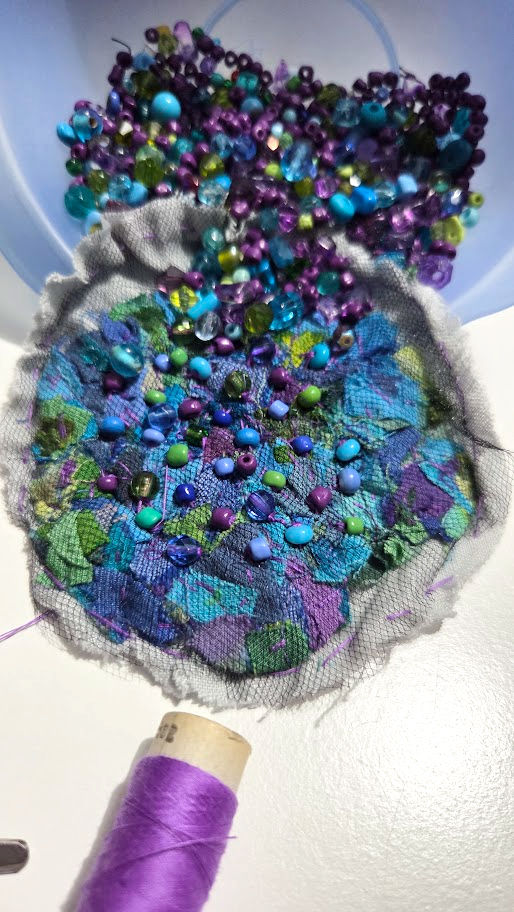
Working small changes how fabric scraps look
Scraps can get lost when they are scattered across the table.
A narrow strip. A corner cut from a larger composition. A tiny section where two fabrics overlap. A bit of cloth with a line of stitching already in it. These pieces can look leftover, almost accidental.
But when I begin making accessories, they stop looking like leftovers.
A small scrap can become the center of a brooch. A narrow strip can suggest a horizon line, a wave, or a fold of movement. A tiny area of hand stitching can become the most important detail in a pendant.
The scale changes everything.
On a larger textile piece, a small scrap might disappear into the whole. On a piece of wearable art, it can become the whole story. The mark, color, and texture are easier to see because there is less surrounding noise.
That is one reason fashion accessories are such a satisfying way to use remnants. They do not feel like a compromise. They feel like a natural continuation of the bigger work.
The scraps I am using now come from the wave landscape pieces I recently finished. Those pieces are waiting patiently for binding, which will happen when the weather cools a bit. In the meantime, their remnants are becoming something else.
I like that connection. The brooch and pendant are not copies of the larger pieces, but they belong to the same family. They carry the same colors and textures.
There is also less waste. Tiny pieces that might otherwise sit in a basket for months are being used while their source is still fresh in my mind.
The first completed piece was a fabric brooch
The first accessory in this new series is a fabric brooch.

A brooch is a lovely format for slow stitching because it is small but still visible when worn. It can be quiet or bold. It can sit on a jacket, a scarf, a bag, or a simple top. It does not need to follow the rules of commercial jewelry. It can be soft, uneven, layered, and textural.
That makes it ideal for fabric scraps.
For the brooch, I began with fragments that already had a relationship to each other. The colors came from the larger textile pieces, so there was already a sense of belonging. I did not need to search for a palette from scratch.
The pendant is now taking shape
After the brooch, I moved on to a fabric pendant.
Again, the scraps are leading part of the way.
The pendant is not finished yet, and I am enjoying that middle stage. There is enough done to see where it is going, but still enough unfinished space to keep the conversation open.
Planned work and intuitive work can sit side by side
This accessory series feels more planned than the intuitive textile work I have been doing, but I do not see these two approaches as opposites.
They feed each other.
The intuitive work keeps my eye open. It reminds me to respond to what is actually happening in the cloth rather than forcing a fixed idea. It gives me permission to adjust, cover, reveal, and change direction.
The accessory work gives me structure. It asks me to make decisions within a known form. It makes me think about function, scale, and wearability. It turns scraps into finished objects with a purpose.
If I spend too long on intuitive work, I sometimes want the satisfaction of a defined finish. If I spend too long on planned pieces, I miss the surprise of not knowing where the work will go. Having both on the table gives me a way to follow my energy.
That has been especially useful during this hot spell. Large work can wait. Binding can wait. The machine can wait. But the ideas do not have to wait.
Small accessories create room for many ideas
One reason I am excited about this series is that fashion accessories offer so many possibilities.
A brooch and a pendant are only the beginning. Fabric scraps can become all kinds of wearable or usable pieces, especially when slow stitching is part of the surface.
I am thinking about:
fabric cuffs with layered scraps and dense hand stitching
small stitched charms for bags or keys
soft textile beads made from wrapped and stitched remnants
fabric tabs or accents for scarves
hand-stitched patches that could be pinned or sewn onto garments
small neckpieces built from several stitched units
textile buttons or closures with decorative surfaces
and there are more ideas
The beauty of knowing what comes next
In some creative seasons, I want surprise. In others, I want a path.
Right now, knowing what I am sewing feels good.
I know I am making a series. I know the series begins with slow stitched accessories. I know the materials come from scraps and remnants already connected to recent work. I know the first brooch is complete. I know the pendant is underway. I know there are more ideas waiting.
Instead of wondering what to start, I can choose the next small form. Instead of pulling out every fabric I own, I can begin with a focused pile of remnants. Instead of waiting for perfect studio conditions, I can stitch by hand in the cooler parts of the day.
There is still room for choice, but not so much that the work stalls.
I think this is one reason planned small projects can be so useful. They lower the barrier to beginning. They turn a vague desire to make something into a specific action.
Thread the needle.
Choose the scrap.
Sew the first stitch.
That is enough.
Slow stitching makes time visible
Each stitch is a small record of attention. The line may be even or uneven. The thread may sink into the cloth or sit on the surface. The hand may move faster in some places and slower in others.
Machine sewing can create beautiful lines too, of course. It has its own language. But hand stitching carries a particular intimacy. It shows the hand more directly. It allows for softness and irregularity.
In a small accessory, those marks become especially important. There is not much space, so every stitch matters. A row of running stitch can become a design element. A cluster of tiny stitches can hold a focal point. A reinforced edge can become both structure and decoration.
Slow stitching also changes how I experience time while making. It does not feel like time spent waiting for the weather to improve. It feels like time used well.
The quilts will still need binding. The machine will hum again and larger work will return.
A few lessons from working this way
This current series has already reminded me of a few things I want to carry forward.
Small work deserves serious attention.
A brooch or pendant may be quick compared with a quilt, but it still needs care. The scale is smaller, not less important.
Hot weather can change the process without stopping work.
Creative practice does not need to look the same every season. Sometimes the best work is the work that fits the day.
Planning can be just as calming as improvising.
I love intuitive stitching, but there is a different comfort in knowing the destination before I begin.
Wearable pieces need both beauty and function.
A textile accessory has to look good, but it also has to feel good to wear. The back, edge, weight, and attachment matter.
These lessons are simple, but they are shaping how I think about the next pieces.
What comes next in the series
The fabric pendant is still in progress, and I am looking forward to seeing how it turns out. After that, I have more accessory ideas waiting. Some may stay close to the brooch and pendant format. Others may move into cuffs, charms, or more experimental wearable pieces.
I also plan to keep working on intuitive pieces in parallel. That balance feels right. One practice gives me freedom, and the other gives me form.
When the weather cools down, I will return to the quilts and sew the bindings on the larger textile pieces. I am looking forward to that stage too.
For now, though, the small work is enough.
A handful of scraps. A needle. Thread. A clear idea. A slow line of stitches.
That is where my attention is, and it feels like exactly the right place to be.
I am sharing the creative journey and all the details in the Meditative Slow Stitch Fashion collection on Patreon and it is available to subscribers of the PriganArt Stitch Society - https://www.patreon.com/cw/PriganArt


Comments