A Trunk Show

The weather has been changing here, and I can feel that shift before I even sit down to sew. The light is softer, and the air is cleaner and the sky is darker.. It’s the kind of season that makes me want to turn on a lamp, make a huge mug of buttered coffee, and finally finish off those pieces that have been waiting patiently for their edges to be bound.

So that’s what I’ve begun doing, I am working on my trunk show.
What is a quilt trunk show?
A quilt trunk show is a gathered presentation of quilts, usually centered around a theme, artist, technique, or body of work. In this case, the trunk show will be shared on the site and will include art quilt pieces and samples made over years of teaching and creating tutorials.
Why do tutorial samples matter?
Tutorial samples show how a technique can change with different fabrics, colors, stitches, and layouts. They help people see that there is more than one good result, which makes the technique feel more open and approachable.
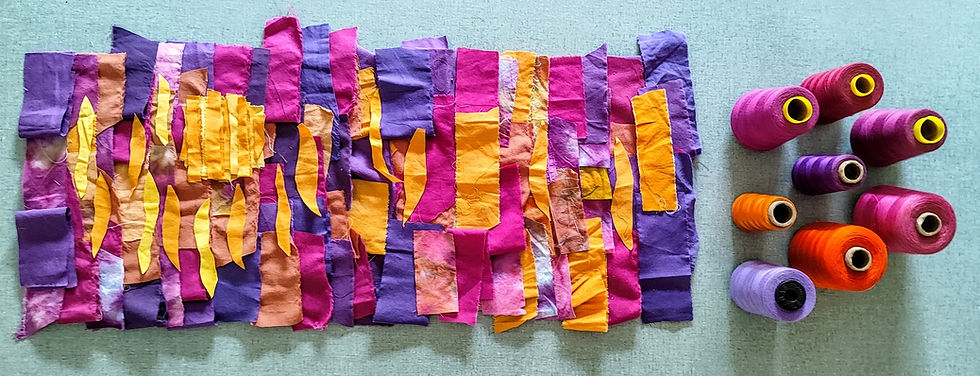
sunrise strip collage art quilt desert strip collage art quilt
I’m binding quilts for my trunk show, and the process has become much more than checking a task off a list. As I open boxes and look through piles of quilts, wallhangings, hand stitched samples, unfinished pieces, I’m finding years of work inside. Some pieces are already bound and ready for hanging. Some are quilted but still with unfinished edges. Some were made as teaching samples for tutorials, and others were created simply because I had an idea and wanted to see what would happen if I pushed a technique and experimented a little further.
I am actually surprised by how many sewn pieces I have amassed over the years. Whenever I create a new tutorial, I rarely make only one sample. I make several. I test the technique with different colors, different shapes, different stitching, different moods. I want to know what happens when the same technique is used to create different pieces, tranquil, bright, happy, neutral, harsh, cool, or dense and busy. These ideas and samples help me to develop a broad curriculum for the classes that I teach.
They are a record of experiments, questions, practice, and possibility.
Not all of the pieces will be bound. Some will be used as appliques to embellish a bag or a pillow and others ask to be sewn onto a background and then stretched over a wooden frame.
I’ve been laying pieces out in the studio and asking simple questions before I cut the strips:
Does this piece need a frame or should it be bound?
Should the edge blend in or make a clear line?
Is the piece better with a narrow or wide binding?
Will the binding help it hang cleanly and look finished?
Those are the questions and in another post I will show how I address them.
Opening the boxes and visiting old ideas
I knew I had samples. I did not remember quite how many. That’s the funny thing about creating over many years. You finish one tutorial, move onto the next, sort the fabrics for another idea, teach something then test something else, and keep on experimenting and creating The pieces stack up and before I know it I have to find another container for all the pieces.
I’ve been finding little stitched records of what I was thinking about at different times. Some pieces remind me of a color combination I loved. Some remind me of a class or a tutorial where I wanted to make one technique more user friendly. Some remind me of questions that I had while working, like how sheer layers would look over printed fabric, or how much I could applique onto a small shape before it became overpowering.
There are many finished pieces that just need binding. There are others that I see differently after leaving them in the box for a few years. I have changed, and my sewing and quilting style develops all the time and if I were creating these pieces again I would change a few things on some of the pieces, work differently. A few have made me laugh because I can't understand, from where I am today, how I ever created something like that. A few have surprised me because I like them more now than I did when I first made them.
Time gives you a little distance from your own work. When I have just finished a piece I can still feel every decision I made. I remember the thread that broke, the color I changed, the seam I picked out, the moment when I wondered if it was working, and then the moment when it did work!
Some of the unbound pieces were not unfinished because anything was wrong with them. They were unfinished because I had already learned what I needed to learn from them at the time. I had created the sample for the tutorial or the class, taught the technique, moved on to the next one and left the finishing for later.
Tutorial samples also teach me
One of the best parts of preparing this trunk show is seeing how many different directions can grow from the same technique.
That may be the thing I love most about teaching. A technique is never just one finished look. It’s a starting point. Once a person understands the basic idea, they can make it their own through their fabric choices, scale, stitch, spacing, color, and composition.
That’s why I make multiple samples when I create tutorials. One sample can show the steps, but several samples show the possibilities.
The same method might look tranquil when made with soft neutrals and minimal stitching. It might feel dramatic with strong color and larger shapes. The technique may be the same, but the visual result can change completely.
That matters because people often look at a finished piece and think they need to copy it exactly to be successful. I don’t want that. I want the samples to say, “Here’s one way, and here’s another, and here’s what happens if you try something different.”
The trunk show gives me a chance to gather those options in one place. II want to show the tests, the alternate colors, the small studies, the tranquil and the bold.
Art and sewing develops through trying things. The more I look through these boxes, the more I appreciate the value of all those extra samples. They show my process in a way that a single finished quilt cannot.
And for anyone who enjoys quilt art, teaching sewing, and quilting, a trunk show of art quilt techniques, showing the different options can be especially helpful because it connects the finished work to the learning behind it.
Online, the pieces can be viewed slowly. People can return to them, compare them, and notice details. Even though a trunk show has roots in showing work in person, sharing it on the site gives the collection a different kind of life.
It can be visited from home. It can be seen by people who live far away. It can hold notes, images, and related tutorials in one place. It can make the teaching part more visible.
And since so many of these pieces began as tutorial samples, that feels right. As a teacher, the real value of keeping samples is that they show evidence of growth.
That is the heart of teaching creative work. The goal is not to make everyone arrive at the same finished piece. The goal is to help people understand enough to begin making their choices with confidence.
Samples are wonderful for that because they take the pressure off perfection. A sample is allowed and should be, curious. It’s allowed to test one idea and also show variations. It doesn’t have to be a grand finished masterpiece.
And yet, many samples become beautiful in their own right.
That’s what I’m seeing now. These pieces were made to teach, test, and explain, but they also have their own presence.


Comments